NAAC Accreditation process:
NAAC’s process of quality assurance is similar to those that are followed by the other Quality Assurance (QA) agencies present worldwide.
According to the Revised Accreditation Framework (RAF) 2020, the NAAC has a timely step-by-step ICT-enabled accreditation process. The new process Student Satisfaction Survey, Data Verification, and Validation that augments the whole objective of NAAC.
We could feel your pressure to get NAAC accredited. We, therefore, have broken down these three big processes into seven steps, without affecting its flow. We assume you find this easy and helpful to follow.
Here is the order of the nationally accepted NAAC Process,
- HEIs registration in the NAAC website
- Institutional Information for Quality Assessment (IIQA)
- SSR submission on acceptance of IIQA (On rejection, an institute has 2 attempts to RESUME the IIQA form within 1 year)
- Proceed to Data Validation & Verification (DVV) process and Pre-qualifier Score
- Preparation towards the Student Satisfaction Survey (SSS)
- Peer Visit by NAAC
- NAAC announces the Institutional Grading
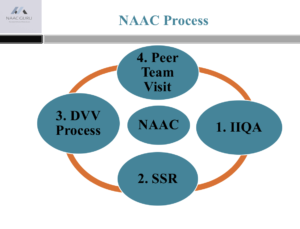
Majorly there are 4 steps in which the entire NAAC Accreditation process is done, which are as follows,
- IIQA Submission
- SSR Submission
- DVV Process
- Peer Team Visit (PTV)
First of all an institution needs to get an Institutional login Id from the NAAC Portal simply by registering institution on NAAC Portal. There are no charges for registering institution ! that is called HEI’s registration in the NAAC Website.
-
IIQA ( Institutional Information for Quality Assessment)
Once HEI’s registration is done online, Next main step is to institution go for IIQA Submission.
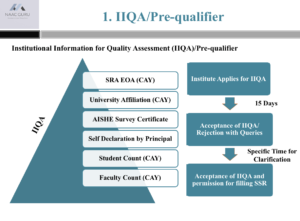
For the Submission of IIQA ( Institutional Information for Quality Assessment) mainly the documents required are,
(i) SRA ( Statutory Regulatory Authority ) like UGC / AICTE Extension of Approval (EoA) for Current Academic Year (CAY)
(ii) University affiliation letter for current academic year (CAY) for all programs,
(iii ) All India Survey of Higher Education (AISHE) Registration Certificate,
(iv) Self Declaration regarding programs and courses by Principal
(v) Registration fee: DD in favour of Director NAAC – Rs. 25,000 + GST as applicable. Also this could be easily paid online also from NAAC portal.
Key Points related to IIQA
- Upload first IIQAduring the year starting from June; along with prescribed registration fee – Link is open throughout the year.
- If IIQAis rejected, two more chances within the same fees – NAAC will communicate reasons f or rejection – overcome deficiencies and upload again,
- IfIIQA is accepted , upload the SSR on the NAAC Portal within 45 days from the date of acceptance of IIQA along with 50% of the prescribed
- In case of failure to upload SSR within 45 days; you will have to start the process afresh along with registration accreditation fees
- SSR uploading is nowopen throughout the year
- No hard copy ofIIQA & SSR – submission of documents only ONLINE now
2. Self Study Report (SSR)
Once IIQA is submitted the next process is filling Self Study Report (SSR). This is the most important step since entire scoring is NAAC grade depending on this stage.Institutions will have to gather information and corresponding documents year-wise for 5 years for all the robust 7 criteria based on quality scoring of NAAC. For this, it is important to institutionalise a structured Data/ Documentation MIS Portal for ready availability of data and documents. Once IIQA is submitted, from the date of IIQA submission institute gets a countdown of 45 days to submit SSR on NAAC portal. We suggest institute to first prepare SSR and then submit IIQA so that they can take special care in preparation of the huge data required in SSR preparation and also to avoid anxiety and end time preparation mistakes.
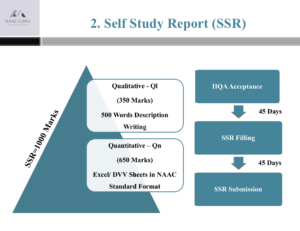
SSR Format needs two sets of documents – Qualitative and Quantitative. 41 Metrics for affiliating and 38 for Autonomous Colleges – mostly write-ups. Documents will depend on the claims of attainment we make in our write ups.
In case of Quantitative Metrics, list of documents required are listed in the NAAC Manual and the Standard Operating Procedure (SOP), also available on the NAAC Website. They need to be arranged as per list contained in each Metrics or respective SOP. Physical documents to be made in to e-verifiable documents.
Some Key points for DATA & DOCUMENTATION of NAAC
- Institutions will have to gather information and corresponding documents year-wise for 5 years. For this, it is important to institutionalise a structured Data/ Documentation MIS Portal for ready availability of data and documents
- Make it mandatory for faculty/staff to compile and upload Annual /Semester/Monthly Performance Report, for ready availability of data.
- Data Gaps negatively affects averages and weighted score and finally on NAAC Grade !
NAAC GURU with NAAC SSR Software could help you in faster report generation and improve your NAAC grade and the CGPA points. The institution not only gets to collate and upload the complicated NAAC documents easily but also gets to evaluate itself on various parameters and find ways for improvement for that we provide consultancy contact points as well along software.
3. DATA Validation & Verification (DVV) :
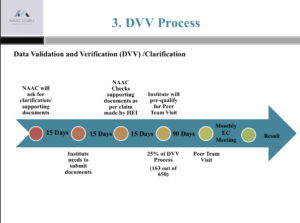
This process is simply for ‘DOCUMENTS VERIFICATION’ in short,
Every claim made by the institution needs to be verified and validated thats why it is called as data validation and verification. Verification is important particularly when claims could be doubtful, manipulated, exaggerated in the SSR. As members of Peer Team, we have come across a lot of even understatement of claims in large number of colleges.
When we talk about prior to 2017, most of the claims used to get verified during PT interaction with faculty/departments/office etc. Yet there was physical verification of relevant documents for which one session was provided during PT visit, when all documents used to be arranged in the institution to facilitate formal verification.
Instructions in the form of Standard Operating Procedure (SOP) for DVV are available on the NAAC Website to avoid any confusion. You may refer your institution SOP with Manual as per the category, i.e. General Institution, Health Science Institution etc..
SOP has listed all the relevant documents and supporting evidence needed for each of the Matrices.
The Physical Documents to E-Documents:
Any institution seeking accreditation will have to convert the relevant documents from physical to electronic format for online submission and e-verification.The size of data and the documents to be uploaded may vary from institution to institution; but the NAAC Portal may have restrictions.
In case the documents size is more than what NAAC Portal will take, the same may be uploaded on the institutional website with a link to NAAC Portal.For this purpose, colleges will have to make the Website facilitative and dynamic. This will also help colleges to accelerate shift to e-governance and paperless administration.
DVV Timeline & Some other Important Key Points:
- Timeline : No flexibility in deviation with respect to Quantitative Data Metrics.
- Every claim needs to be supported with documents, such as minutes of meetings, decisions, statements of accounts , letters/ orders/notifications, certificates, approvals, etc as specially mentioned. they are in bulk, hyperlink to the appropriate website may be given.
- There is fixed timeline forthe entire DVV process, which is to be strictly followed. If not responded with in the stipulated time, whatever values uploaded before expiry of timeline, will be taken as final – no extension of timeline.
- Failure to upload full data/documents will adversely affect institutional score. Wherever Asterisk Red Mark* appears, it should be understood as mandatory requirement.
What if Reconstruction of Documents Required ?
Data unaccompanied by relevant e-verifiable documents will make the data redundant . If the documents are not available with the primary external sources (like university, government), institution will have to reconstruct the document from internal sources (office or recipient faculty) – as all the correspondence from the external agencies must have been received by the teacher or college office Such documents will have outward numbers, date and address of the issuing authority along with copy endorsement. Gather missing documents from endorsed entities and upload on your website for e-verification.
4. Peer Team Visit (PTV)

Key Points :
- This stage is called as Pre-qualifier stage (eligibility) for PT visit if :
– DVV is accepted, and Institution scored a minimum 30% score (163/650 Marks) on the Quantitative Matrices (excluding SSS) earlier it was (195/650 Marks)
- PT visit is organized with in 30 days from the date of clearing the pre-qualifier stage
- It may be of 1 or two days
- PT will confine to the 30% Qualitative Aspects & the institutional SWOC
- PT will interact with stakeholders, verify documents, facilities and any other issues which may be referred to NAAC
NAAC accreditation is a robust process , dealing with 7 criteria and several key indicators (KI’s) is more complex. NAAC’s criteria require a lot of Data & reports—reports of the big five years as per NAAC required standard formats, which is seems to be a tough and time consuming task. Those oodles of data and documentation are sure to take your time allot. Compiling all of them by yourselves might seem a possible task But be watchful of that whether the data is in formats as required by NAAC or not, Whether the reports could be generated as per required formats or not. Your NAAC accreditation is a serious deal and we deal it seriously and You seriously cannot risk here with NAAC grade.
If you want to know more about NAAC Accreditation. I have documented everything here NAAC Accreditation: A step for quality education system in higher education